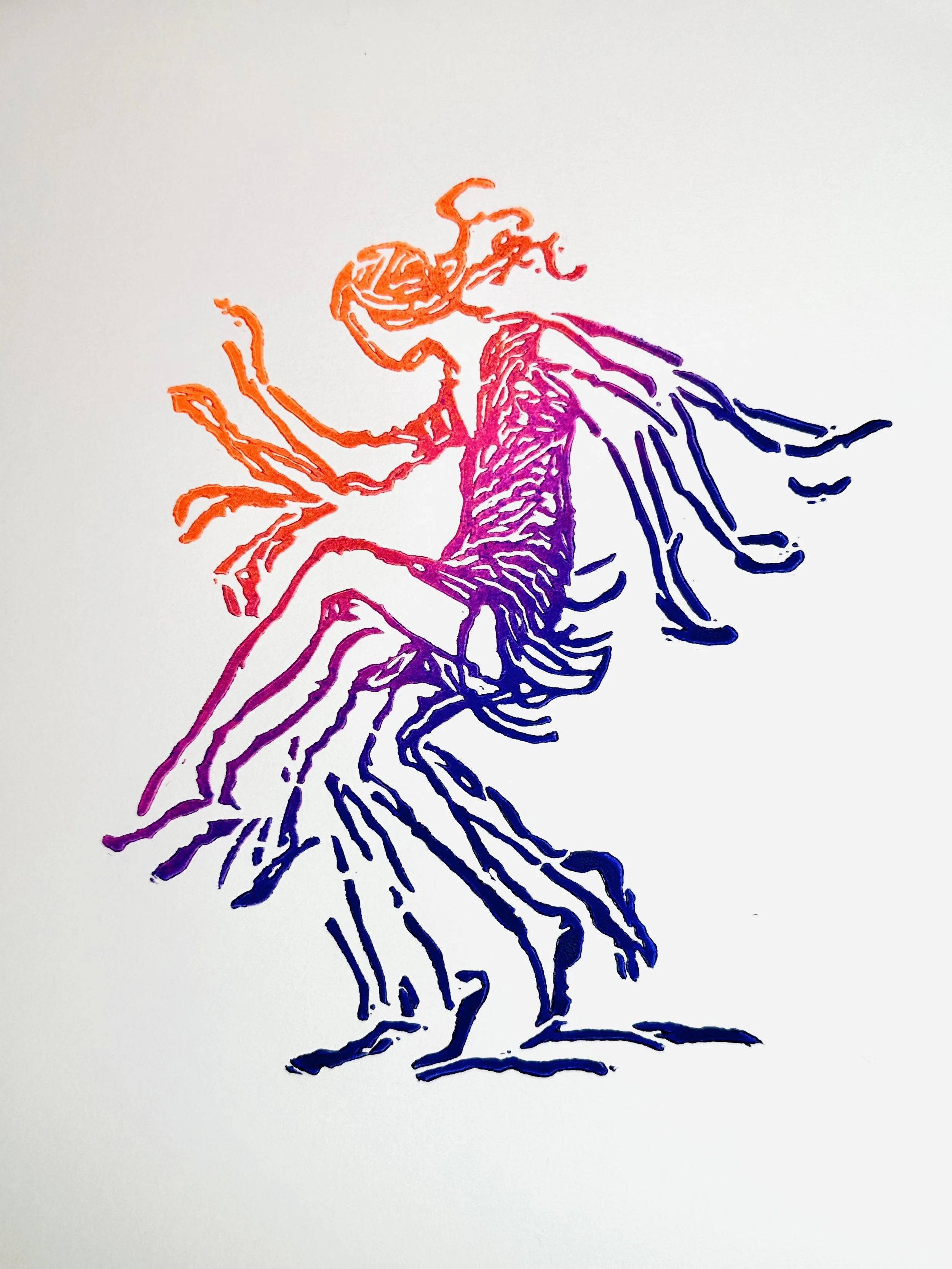
Dancer
Rubber stamp print of Dancer from ~100 year old drawing tutorial.
Source: Internet Archive Book Images
Text Appearing Before Image:
Fig. 91. Pattern formed by the Movement of Fish in the Water with kites ; children rushing along a flat surface bowlingtheir hoops ; a flock of startled geese rising from a marshymere; a cluster of grubbingsparrows among the puddlesof a muddy street; a flock ofsheep chased by a dog; aslow procession of cows mov-ing along a lane—all and eachmove in a certain pattern. You will ask, is it possiblefor anything to move with-out making some continuouspattern ? The answer is thatthere is no end to movement.We dance, and our arms andlegs follow the curves andactions of our body. Werun, and the same thinghappens in a different degree.The dog wags his tail, not in one, but in many continuousmovements. 173
Text Appearing After Image:
Fig. 92. We Dance Drawing for Beginners When we wish to plan a drawing or painting we must put this sense of movement into our picture. Obviously our figures and objects will bestationary, but there must bea sense of movement thatcarries the eyes pleasantlythroughout the whole. Wemust make patterns, andevolve action or rhythm be-tween each object. If we pick up a book, at-tracted by the first page or thefirst few chapters, and we findthat there is nothing furtherto hold our interest, what dowe do but discard the book ?So it is with a picture. Wemust arrest the eye. But we must also hold the interest pleasantly within the picture. We must not put something down which says Stop ! and then treat the subject in such a barbarous manner that the eye wanders dis-satisfied out of the picture. We must, like the writer of the book, give something more than a first attraction. Take as an example the simplest instance, that of a sheet of paper containing an upright line. If we have one